
Seeing The Trees Outside India’s Forests
A new WRI India paper explores how growing trees in agroforestry systems — a landscape restoration technique where farmers add trees to their land — and in and near cities can bring socio-economic and ecological benefits to people and the planet. The Government of India has long recognized that trees grown in agricultural lands and on homesteads can fulfil food and fuelwood needs for rural communities. In 2014, it became the first country to develop a national agroforestry policy. Through several policies and regulations enacted over the years, India’s policy framework provides multiple incentives that promote agroforestry, urban forestry and other approaches to increase the number of trees outside forests. But despite the enabling policy conditions, farmers and other practitioners still struggle to sustain and enjoy the benefits of these systems.
Mobilizing a Movement to Scale Up Trees Outside India’s Forests
We identified 10 types of incentives — seven monetary and three non-monetary — that policymakers use to encourage farmers to grow trees. Subsidies for planting material (like saplings) and infrastructure (like greenhouses and irrigation) emerged as the most commonly available and utilized incentives, followed by direct technical assistance to farmers from government agencies. Across those ten types of incentives, common themes emerged among the most successful policies, those that improve the quality ecosystem services, such as clean water and healthy soil, and the incomes and resilience of the local communities that rely on them. Various actors have a role to play in helping farmers embrace different systems to ensure this success:- Political and bureaucratic willingness and support spurred comprehensive programs like Green Gujarat in Gujarat, Krushi Aaranya Protsahan Yojna in Karnataka, Mission Plantation in Maharashtra, Greening Punjab Mission in Punjab and Telanganaku Haritha Haram in Telangana. These flagship schemes converged financial resources from several policies and involved multiple government departments in their implementation. These governments also established mechanisms to monitor where their programs are leading to the expansion of trees outside forests. These systems, however, still need to be made more ecologically and socially appropriate, inclusive and transparent.
- NGOs often played a critical role in connecting the government’s schemes with farmers on the ground. In many large-scale programs, such as the wadi development program of the National Bank of Agriculture and Rural Development (NABARD), NGOs raised awareness of policies among farming communities, improved access to finance and material resources, and provided technical training.
- Several research organizations and state agriculture universities are developing new agroforestry models and techniques that are specific to the agricultural, social and climatic conditions of each landscape, which can help farmers maximize the function and yields of trees.
- The private sector connect farmers with markets for their tree crops, such as buying their wood products for paper mills. In recent years, several innovative business models and entrepreneurs have emerged who have successfully combined profit with sustainable use of land. Araku Coffee and Black Baza Coffee, for example, combine shade-grown coffee with ecological corridors that protect biodiversity and the climate. These business models highlight how local communities can be involved in the sustainable growth and production of high-quality consumer products.
Native Trees: A Missing Piece of the Puzzle
Even though the policy environment continues to strengthen, the governments of these six states can still improve their current policies. Because these programs are planned at the state level but implemented by local farmers, they can inadvertently subsidize approaches that are socially and ecologically harmful. The most glaring challenge is the lack of incentives for native species and traditional agroforestry models. Though they are prioritized in policy documents, much on-the-ground implementation prioritizes commercial, fast-growing tree species — like Euclyptus and Casurina — that threaten native ecosystems. The pressure to increase tree cover quickly has overlooked traditional agroforestry practices that communities have used to add native trees to the landscape.
How To Improve The Effectiveness of Incentives for Trees Outside Forests
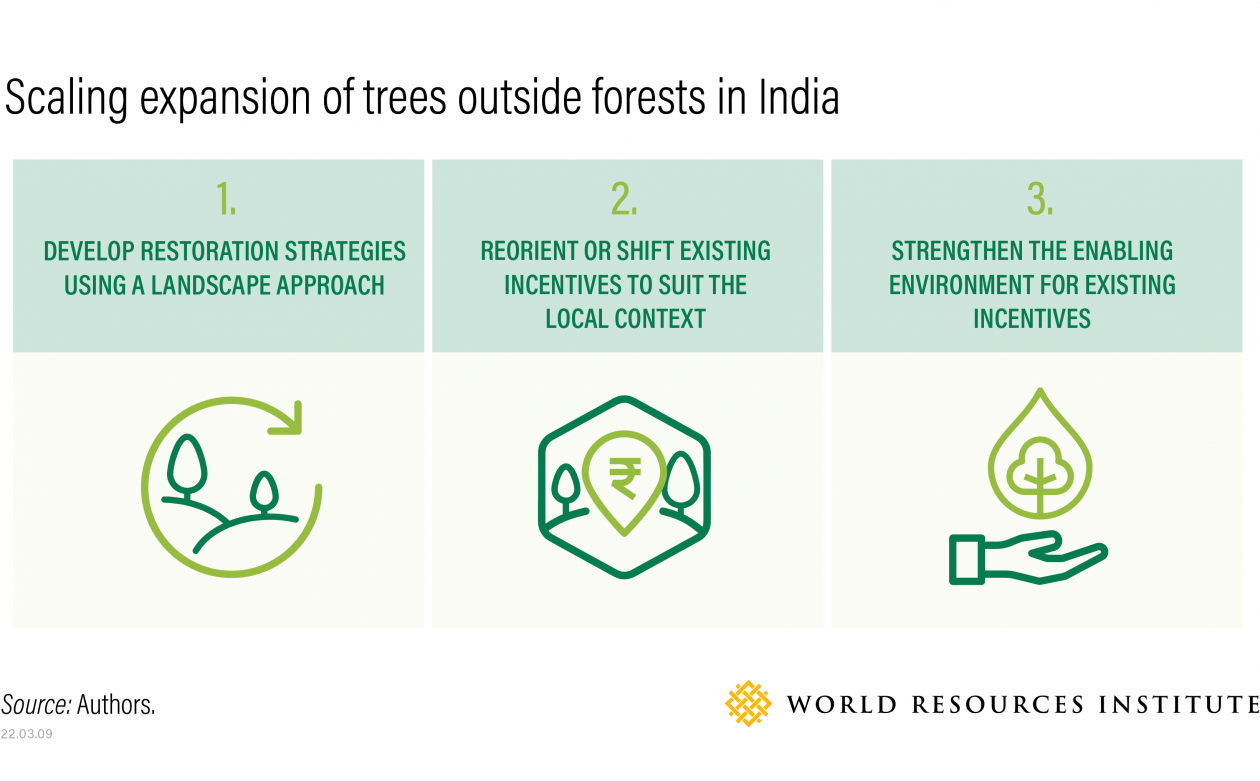
Our findings highlight that India’s immense and diverse experience with policies that help farmers and other practitioners grow trees outside forests and presents how that strong base can improve current incentives and yield better policy outcomes.
